
Another pension warning
Don't leave it until it's too late

You may have seen on the mainstream news this week, a report from Pensions UK which warns that three quarters of workers are not on track for even a “moderate” income in retirement1.
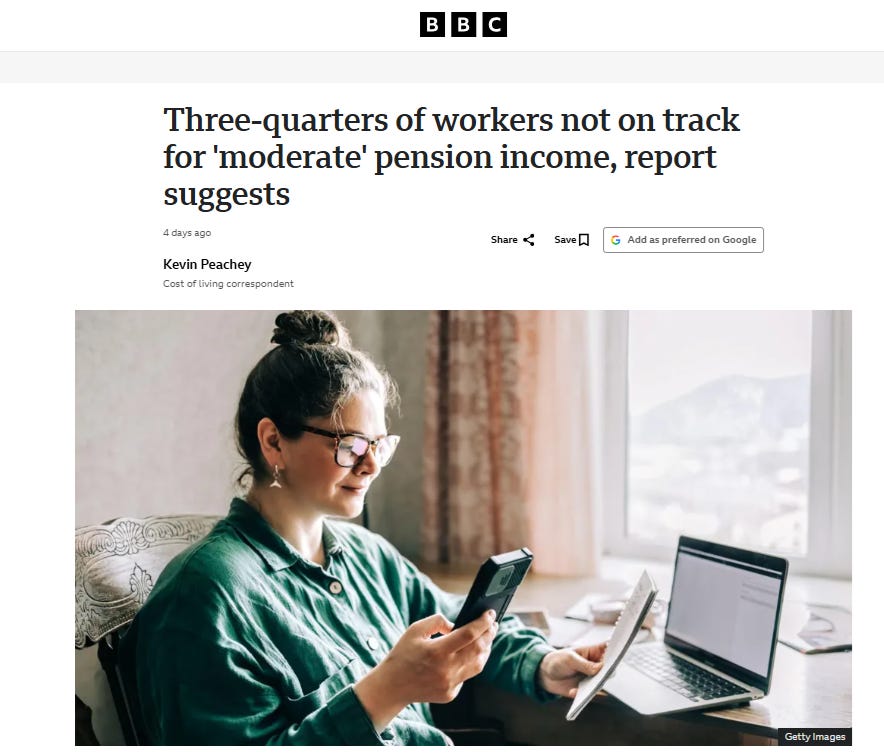
In fact, the report goes on to identify that only 9% of workers will achieve a comfortable pension, defined as £ 62,700 for a couple per year. Most pensioners will unfortunately face a “cliff-edge” drop in income in retirement unless they take remedial action.
One of the main reasons for this is the terrible returns that are generated from most collective pension schemes and savings products sold by UK “asset management” companies. Both of these organisations insist on adding in low, or negative return government bonds (called gilts when applied to UK government bonds) into savings. The addition of low (or negative) return government debt often happens by default and the weight of bonds in a saver’s portfolio increases with age. A recent survey by the UK Department for Work and Pensions2 found that the mean net investment return at retirement was only 2.5% (please note the decimal, that is two-point-five percent per annum over the past five years), in an environment where inflation has been running at around 8% in 2022. At retirement a full two thirds of a typical pension portfolio is invested in cash and bonds and therefore has no realistic prospect of making a reasonable return.
Even for the people who have managed to escape the millstone of government bonds, the plethora of fees charged by most mainstream asset managers will reduce equity returns by several percentage points. For most people this will add up to tens or even hundreds of thousands of pounds of savings forgone. These costs are almost never made up by superior savings performance and in many cases the money taken from savers is simply used to pay sales commissions and provide dividends to the owners of these “asset management” businesses. Costs which generate zero value for savers.
I’ll be writing about some of the dirty tricks some asset management companies use to hide these ugly facts. They range from the simple ruse of quoting returns on a cumulative basis without providing an annualised equivalent, through to slicing costs into different pieces making it almost impossible to understand how much a saver is being charged in total. I’ll also look at more sophisticated tricks like using misleading industry generated (Investment Association) soft benchmarks in order to misleadingly claim “outperformance”.
I have been warning for some long time that based on past performance government bonds can be expected to drag down savings returns (see the post about the Markowitz Hoax3). In addition, the recent steep fall in government bond prices has only made that situation worse. Last month I highlighted the way in which bond prices have fallen, primarily as a result of central bank bond sales and the UK government’s increasing debt burden (see the video below).
Please get in touch if you are worried about your pension returns and wish to avoid living at near subsistence levels in retirement.
Please email: Alex@berkshirewilliams.com or Joanna@berkshirewilliams.com
Any discussion is for informational and educational purposes only. It does not constitute investment advice, financial advice, or a recommendation to buy, sell, or hold any securities or investments. The information presented is based on publicly available data and the author’s own analysis as of the date of publication. All investments involve risk, including the potential loss of principal. Past performance is not indicative of future results. Readers should not rely on any information contained in this article/discussion as the basis for making any investment, financial, or other decisions. You should consult with a qualified financial advisor or conduct your own independent research before making any investment decisions. The author is not an investment adviser. The author and any affiliated parties expressly disclaim any liability for any loss or damage arising from the use of, or reliance on, the information in this article/discussion.
Three-quarters of workers not on track for 'moderate' pension income, report suggests
https://www.gov.uk/government/publications/the-pension-provider-survey-202425/the-pension-provider-survey-202425
£62,700 is a very comfortable pension for a couple - provided that they own their own home, mortgage free. The question of property ownership - and whether or not you have to pay rent for the rest of your life - is the elephant in the room. I suspect that with each passing year, increasing numbers of people will not have this safety net.
what size pension pot will buy a £62k pension?